
Name-Based Case Searches
Start any Emery County court docket search through Utah Courts Xchange, the state's main public tool for district and justice case records. Begin with a narrow query. Pick District Court, Justice Court, or both. Then narrow to Emery County or the specific Castle Dale court location. Fill in the Last Name/Company field. Add a first name only when it sharpens the match. The official help allows an asterisk wildcard, though names under three letters should be typed without one.
- Open Xchange and choose the district or justice jurisdiction.
- Enter the last name or company name, using the supported wildcard when needed.
- Add the first name, Emery County location, case type, or filing-date range.
- Compare county, court, caption, party code, filing date, and case type.
- Open the matching history only after those fields agree.
| Field Label | Type | Required | Use |
|---|---|---|---|
| Jurisdiction | Select | Search choice | District Court, Justice Court, or both |
| Last Name/Company | Text | Optional | Person surname or business name; wildcard supported |
| First Name | Text | Optional | Narrows people with a shared surname |
| Search Scope | Select | Optional | Statewide, county, or particular court |
| Case Type | Select | Optional | Limits results to an official category |
| Date Panel | Date range | Optional | Filters filing, disposition, or judgment dates |
Emery Xchange Search Route
Start at the official Xchange entry page. It offers both guest public search and account sign-in. Underneath it all sits CORIS, the court system Utah clerks type into. The docket data you get back can include parties, judges, lawyers, hearings, case events, judgments, outcomes, accounting fields, and links to some public documents. Just know the limits. Xchange is not a full open-document archive. Classification rules still decide what any member of the public may view in a case record.
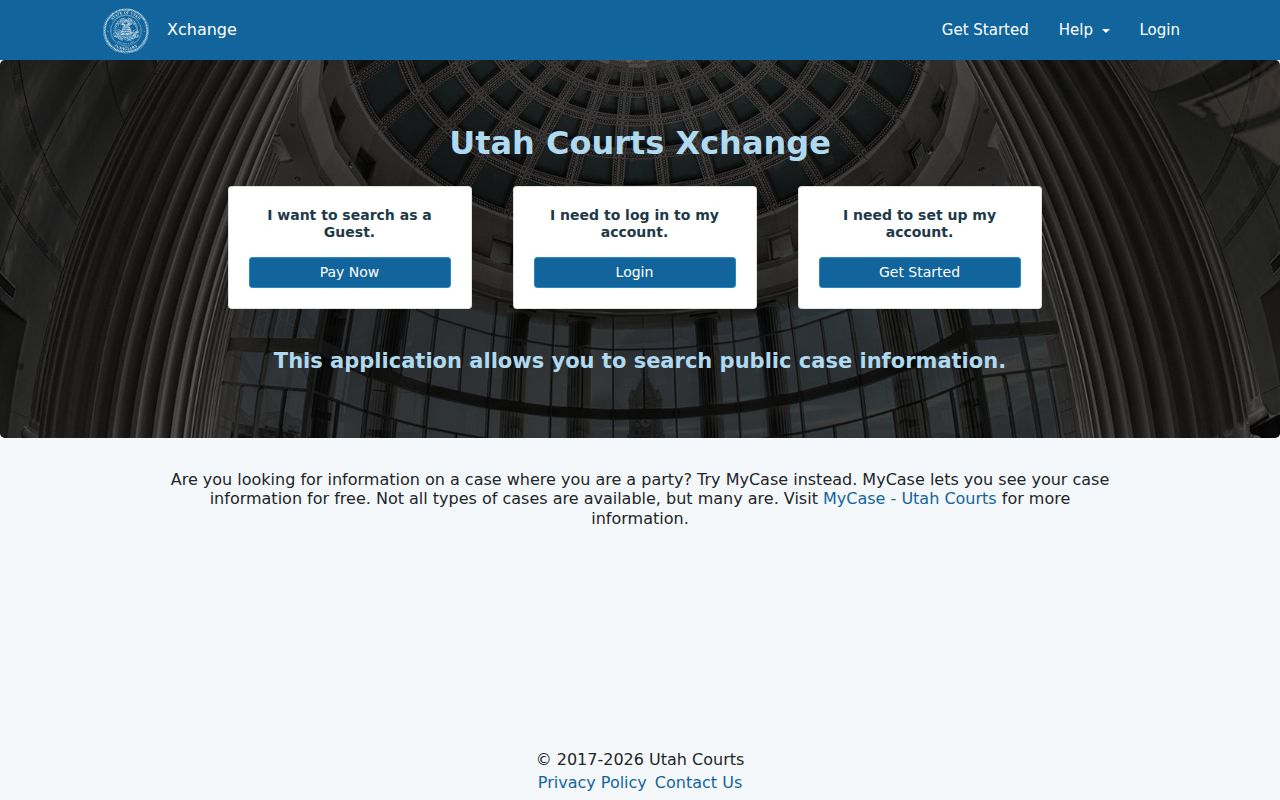
The landing page separates public case lookup from filing, payment, and party-only services. Picking the correct tool up front matters, since a wrong choice can make an open docket look like it returned nothing.
Case Number Searches
An exact case number beats a common name almost every time. Xchange explains that the first two digits usually mark the filing year. The full number is not unique across Utah. So a format like YY######## works as a court-assigned key rather than a statewide identity on its own. Choose the matching jurisdiction and the Emery County court location. Then check the case type, caption, and filing date against what you expect.
MyCourtCase, by contrast, wants nine digits with no letters. That rule belongs to its party portal and does not govern every Xchange search. If a copied number fails, strip spaces or punctuation only when the live form says to. Recheck each digit against the citation, order, or notice. Traffic adds one wrinkle. The citation number sits in its own field and is not always a unique statewide case key.
Emery Search Filters That Matter
Xchange stops a search at 500 results. Run a statewide sweep on a common surname and the one Emery County case you want can drown in the noise. Cut that down first. Pick Emery County and the Castle Dale court location. Then set district or justice jurisdiction, case type, and a tight date window. Note that filing, case disposition, judgment, and judgment-disposition dates work as separate filters, so choose whichever matches the question at hand.
The official Xchange search help lays out every field, the wildcard method, the result columns, and the history tools.
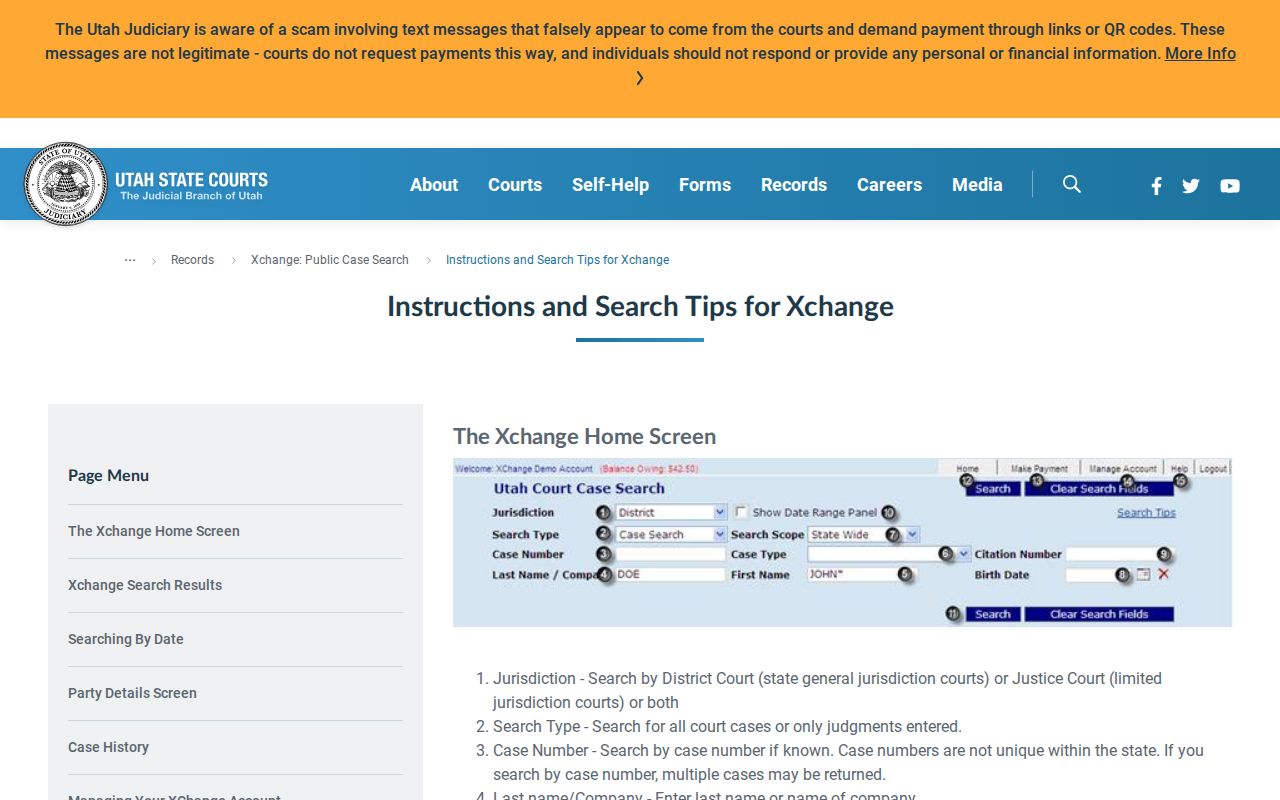
Searching for a company? Put its name in the Last Name/Company box. Use the wildcard where you need it. Alternate punctuation is worth a try, but only if the first pass comes up empty. The stronger play is matching the full caption and filing date, since a business name alone can point to several cases in the docket.
Case Search Results Explained
Think of a result row as an index, not a verdict. It does not show that every allegation was proved. Nor does it show that every dollar listed is still owed. Check the court, the location, the caption, and the party code before trusting a match. Then open the full case history. Read each plea, judgment, disposition, or order in its recorded context.
| Case Number | Court-assigned identifier; pair it with jurisdiction and location. |
|---|---|
| Caption and Parties | Formal case title and people or organizations, with role codes such as PLA, DEF, PET, or RES. |
| Case Type | Official category for criminal, civil, domestic, probate, traffic, or other work. |
| Filed Date | Date the case entered that court's system. |
| Proceedings | Chronological events, settings, filings, and recorded court action. |
| Disposition | Outcome entered for the case or charge; read dismissal, conviction, plea, or other terms precisely. |
| Documents | Links appear only for public items available through the interface. |
| Accounting | Revenue, trust, fine, fee, paid, due, and balance fields when available. |
An empty document list is not proof that nothing was filed. The paper may be private, sealed, undigitized, or simply blocked from public download.
Emery Xchange Guest Access
Xchange sells a one-time guest pass for $10. Each search runs $0.20, and every public document you open adds $1. Want more than a quick look? The monthly plan carries a $25 setup fee plus a $40 monthly charge, and that fee covers 500 searches with a per-search price for anything beyond. Fees on the subscription page can shift, so check the current numbers before you pay a dime.
The official guest registration route lays out the payment steps and the account setup for an Emery County docket search.
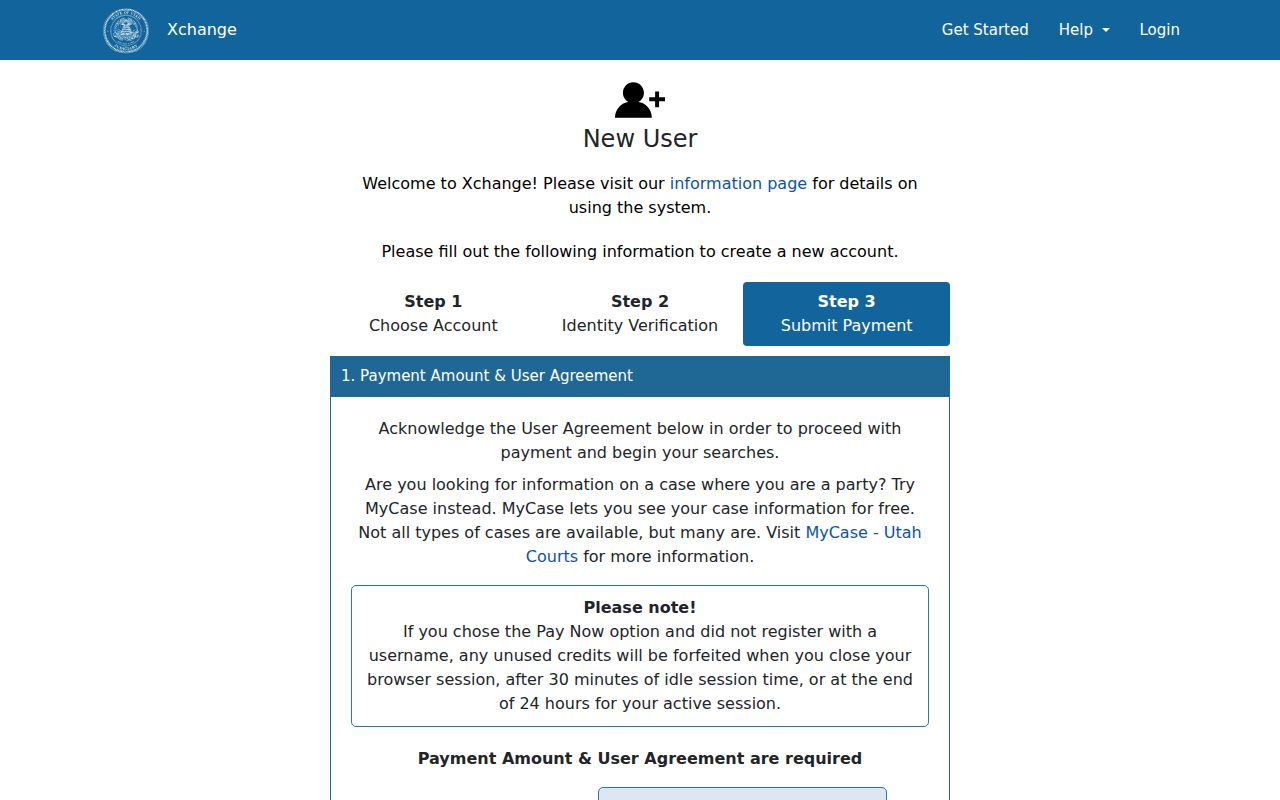
Buy your guest access with a plan, not on a whim. Credits can vanish if the account closes, sits idle for 30 minutes, or hits the end of a 24-hour session without a username. Decide which Emery County court docket entries you want before you pay.
Two Ways to Search: County and State
There is no separate Emery County case database sitting alongside the state system. The real choice is between a statewide Xchange search and a narrower Emery County or court-location search inside the same tool. A second line separates public Xchange access from MyCourtCase, which serves parties and participants pulling up their own supported cases for a court docket lookup.
| Statewide Xchange | Emery-Focused Xchange | MyCourtCase |
|---|---|---|
| Searches participating Utah district and justice records | Narrows Xchange to Emery County or Castle Dale locations | Links a participant to a supported personal case |
| Useful when the county is uncertain | Best when the Emery court is known | Requires email, case number, and government identification |
| May return many similar names | Reduces unrelated county results | Not a public name-search tool |
A public terminal at a Utah courthouse offers one more route. You can inspect the court record system there free of charge, though copies and staff help may still cost you.
MyCourtCase for Emery Parties
MyCourtCase serves a different crowd. Parties can review their own court docket history. That access covers opened filings, hearing dates, and payment tools for supported matters. Registration takes an email, a case number, and a government ID. Debt collection, eviction, small claims, and protective orders all qualify. Name or sex designation changes qualify too. Criminal and ticket matters also qualify. It works well for tracking your own linked case in Emery County. Think of it as a party's window. It is not a public docket search for someone else's name.
The official MyCourtCase description explains who qualifies and what the page can display.
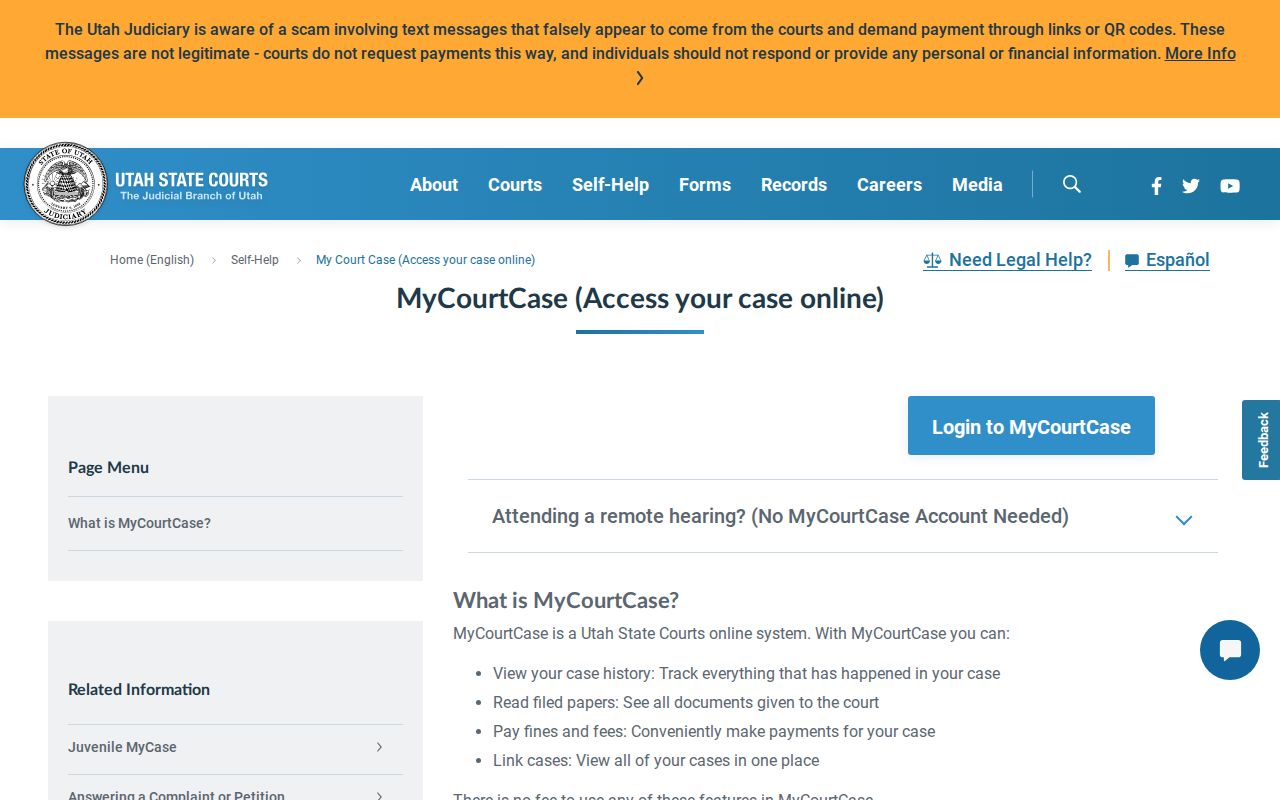
When the portal will not link a supported matter, use its help route or ask the named clerk. Utah eFile is not a substitute. That system handles filings, not public case viewing.
Which Cases Stay Restricted
UCJA Rule 4-202 sets the main framework for court records. Several matter types can be missing from public Xchange: juvenile delinquency, child welfare, adoption, many commitments, expunged cases, and sealed cases. Some private categories still show pieces in public. Domestic, guardianship, parentage, and protective-order cases may display a public case history or an order while the supporting pleadings stay private. A public result does not open every attachment. Rule 4-202.03 says who may reach public and nonpublic records. For anything else, Rule 4-202.04 offers a written access or classification request. The requester names the record and states the legal basis for access. They show identification or authorization if required. They also accept that the clerk may deny the request, redact material, or refer it to a judge. Utah GRAMA governs related government records. Judicial records, though, follow the court's own rules.
When an Emery Search Is Blank
A blank Emery County docket search does not prove the case is absent. Adjust the query instead. Check both district and justice jurisdictions, narrow by location, and drop an incorrect middle name. Then use the permitted wildcard. Castle Dale joined statewide Xchange coverage on January 13, 1997, so older district entries can run thin. Justice courts converted on their own schedule. A fresh citation may still sit in the issuing process before it reaches the court docket.
Use the clerk fallback. Contact the Castle Dale District Court clerk or Emery County Justice Court clerk for old, private, sealed, or document-specific questions.
Submit requests at the counter or by mail with the official Request for Record form. Describe the record in reasonable detail and pick inspection or copies. A phone call can confirm the right office and process. Staff may still want the request in writing. Keep similar names separate. Never republish birth dates, addresses, or minor names. The same ban covers victim information, financial account data, and other restricted material from an Emery County court record.