
Emery County Court Record Requests
The right route depends on the court and the item. Public district and justice case information is available through the Utah Courts Xchange Public Case Search, and some documents are offered there too. A courthouse terminal offers public CORIS or Xchange access and skips the online search charge. Want a paper file, an electronic or certified copy, or something not offered for download? Send the official Request for Record form to the clerk who keeps the case.
District records stay with the Castle Dale District Court clerk. Justice Court files go to that court's clerk. The juvenile clerk runs the narrower access process for juvenile matters. Calling first to confirm custody saves time. After that you can inspect at the counter, mail the request, or use the clerk-approved email channel. Judicial files follow Utah's court-record rules, not an ordinary county GRAMA request.
- Identify the court from the order, notice, case history, or case number.
- Name the case, document, date range, and desired format with reasonable detail.
- Choose inspection, mail, clerk-approved email, or an online public document.
- Provide proof of entitlement if the requested material is not public.
- Confirm the estimate and payment method before sending funds.
Precise Emery Record Descriptions
A narrow request moves faster than a demand for everything tied to a name. Give the court and caption. Add the case number when known. List the document title, hearing or filing date, and whether you want inspection or a copy. Say if the copy must be certified or exemplified. Utah Courts promises a standard response within 10 business days. Classification review, staff research, or payment arrangements can stretch that. The official court-record request instructions walk through privacy review, timing, and fees. The request page there shows how Utah Courts separates inspection from copying and staff work.
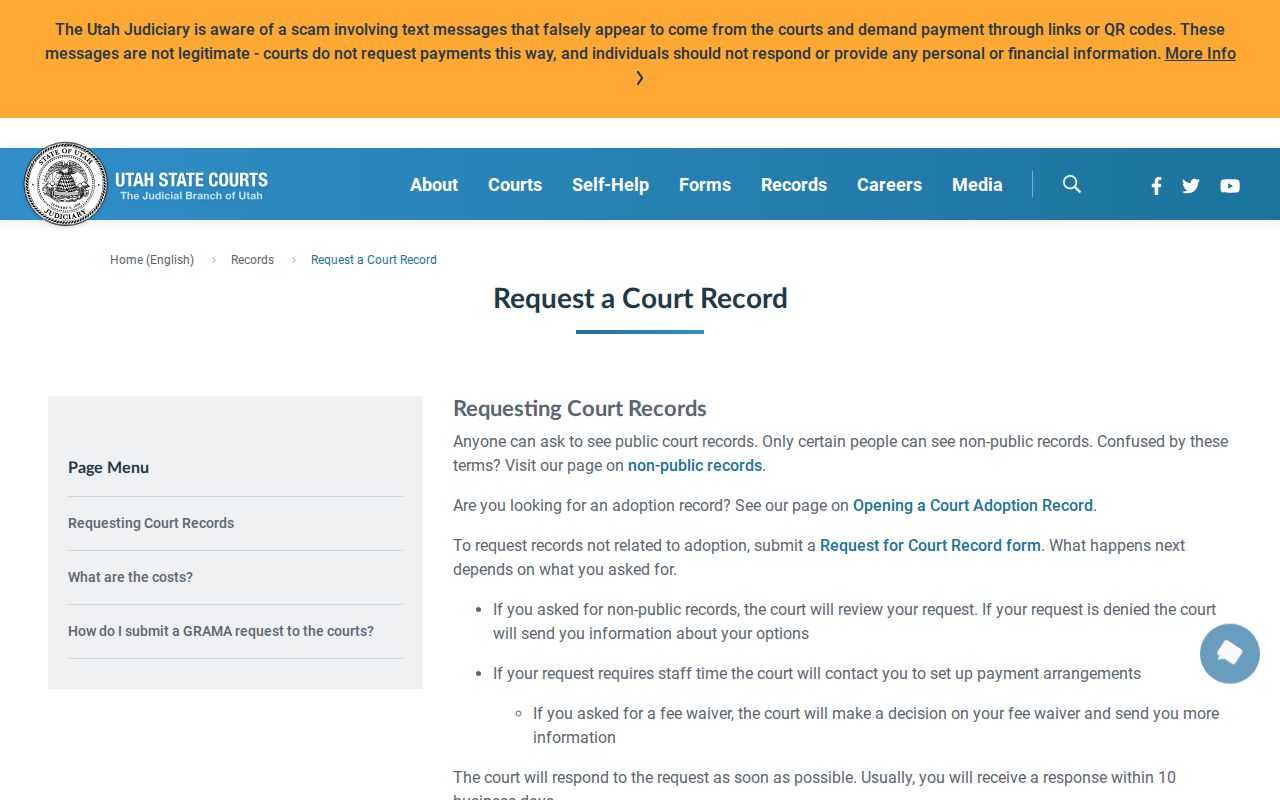
That split matters in Emery County. Viewing a public record can be free even when copies, delivery, or extended clerk work cost money.
Note: Ask the clerk to confirm both custody and current fees before submitting payment or original identity documents.
Kinds of Emery Court Records
Emery County court records reach well past what a search result displays. Utah Courts catalogs case files, indexes, electronically filed papers, older paper records, judgments, hearing recordings, transcripts, weekly reports, and appellate materials. Each type has its own access route and classification.
- Case histories, indexes, and event entries in Xchange
- Pleadings, motions, orders, judgments, and public exhibits
- Audio or video recorded by the court during a hearing
- Certified or exemplified clerk copies for formal use
- Historical files transferred to the Utah State Archives
Records older than 50 years may sit with the Utah State Archives. Anything more recent usually stays with the court or agency that created it. Weekly filing, disposition, and judgment reports are aggregate tools, not a stand-in for an individual Emery County case file.
Emery Hearing Audio and Transcripts
A case history proves a hearing happened. It does not replay what was said. Audio and video requests go to the court that made the recording. For Emery district or juvenile proceedings, Utah Courts lists castledaledocs@utcourts.gov in its recording procedure. You submit the correct form, get an estimate, pay, and then receive whatever recording exists. The official recording and transcript instructions make one thing clear. A recording and a written transcript are separate products.
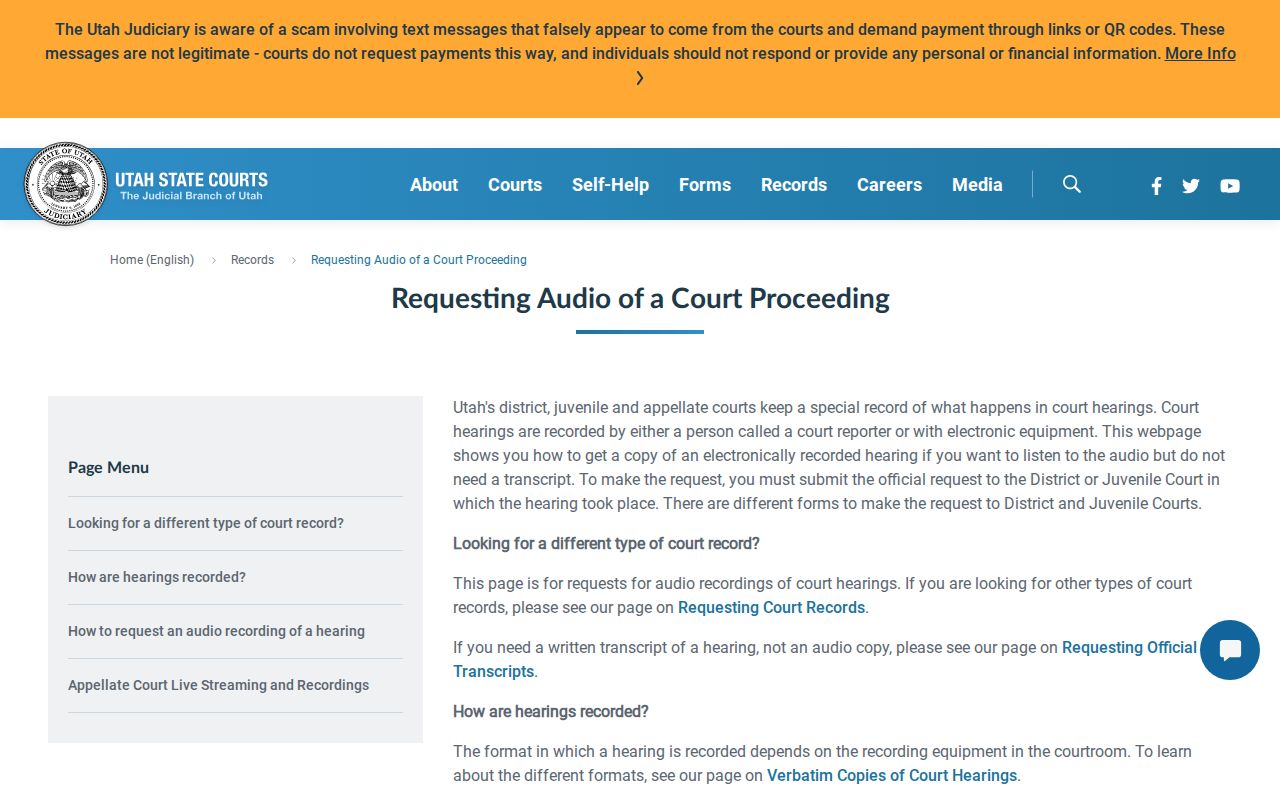
A transcript has to be prepared and carries its own rates. A recording can also be incomplete, unavailable, or restricted, and the clerk can report its status but cannot change a classification.
Emery Court Records: What They Contain
The official case history is the closest Utah interface equivalent to a docket sheet. A full file can add the public papers behind those entries. No single field answers every question, and a document link may be missing even when the clerk holds the filing.
| Case identity | Court, caption, case number, case type, filing date, and current judge. |
|---|---|
| Parties and counsel | Public party names, role codes, and listed attorneys. |
| Proceedings | Chronological events, hearing dates, motions, and minute entries. |
| Orders and judgments | Rulings, decrees, money judgments, and recorded dispositions when public. |
| Documents | Public pleadings and attachments offered online or by clerk request. |
| Accounting | Fine, fee, payment, amount-due, and balance fields when available. |
Domestic matters show the line clearly. A public history, hearing minute, judgment, order, decree, or letter of appointment may stay visible while pleadings and supporting papers remain private.
Older Emery Court Case Files
Xchange helps, but its electronic history has limits. Castle Dale joined the statewide system on January 13, 1997. Earlier data may be incomplete. Justice courts converted on their own schedules. So a blank search can mean older records were never fully converted. It does not mean a case never existed.
Start with the creating court, then ask whether the file was transferred. Historical district, justice, or municipal material may rest with the Utah State Archives. That depends on age and retention. Supply the likely year, court, names used at the time, and record type. That local handoff beats repeating a broad online name search.
Copy Fees and Certification
Inspection is not the same as getting a copy. The current Utah Courts fee schedule controls the cost. Certified copies carry the clerk's authentication, while exemplified copies use a higher-formality certification, so ask the receiving agency or court which form it needs.
| Emery record service | Official amount or rule |
|---|---|
| Inspect a public record | No charge |
| Paper copy | $0.25 per sheet |
| Certified copy | $4 per document plus $0.50 per page |
| Exemplified copy | $6 per document plus $0.50 per page |
| Fax or email | $5 for up to 10 pages, then $0.50 per page |
| Actual cost | |
| Staff time | First 15 minutes free, then the listed rate for the least costly qualified staff |
Courts will not fax or email a record already available through Xchange. The Xchange guest schedule lists $0.20 per search and $1 per available document. Fees can change, so confirm the amount before relying on an old receipt or schedule.
Emery Court Record Custodians
No single Emery County clerk office holds every court file. Each court keeps its own clerk. That clerk is the record keeper for the Emery County court docket you need. The District Court handles felonies, probate, domestic cases, most civil filings, and district judgments. Justice Court dockets cover many traffic citations. They also cover Class B and C misdemeanors, county ordinance cases, and small claims.
Castle Dale District Court Clerk
1850 North Des Bee Dove Road
PO Box 635
Castle Dale, Utah 84513
435-264-4750
Emery County Justice Court Clerk
1850 North 560 West
PO Box 555
Castle Dale, Utah 84513
435-381-5194
Phone note: The Castle Dale number comes from the current Utah Courts listing. The county department directory shows a different district-court number. Callers should confirm against the live directory first.
Access Rules for Court Records
UCJA Rule 4-202.02 opens the door to most court records by presuming they are public. Some files sit outside that presumption. Juvenile cases, adoptions, commitments, expunged matters, protective orders, guardianships, and sensitive domestic filings may be missing or only partly visible. That can happen when you search. The rule itself lays out which records count as public, private, or sealed. That same framework governs what the clerk can release from an Emery County court docket.
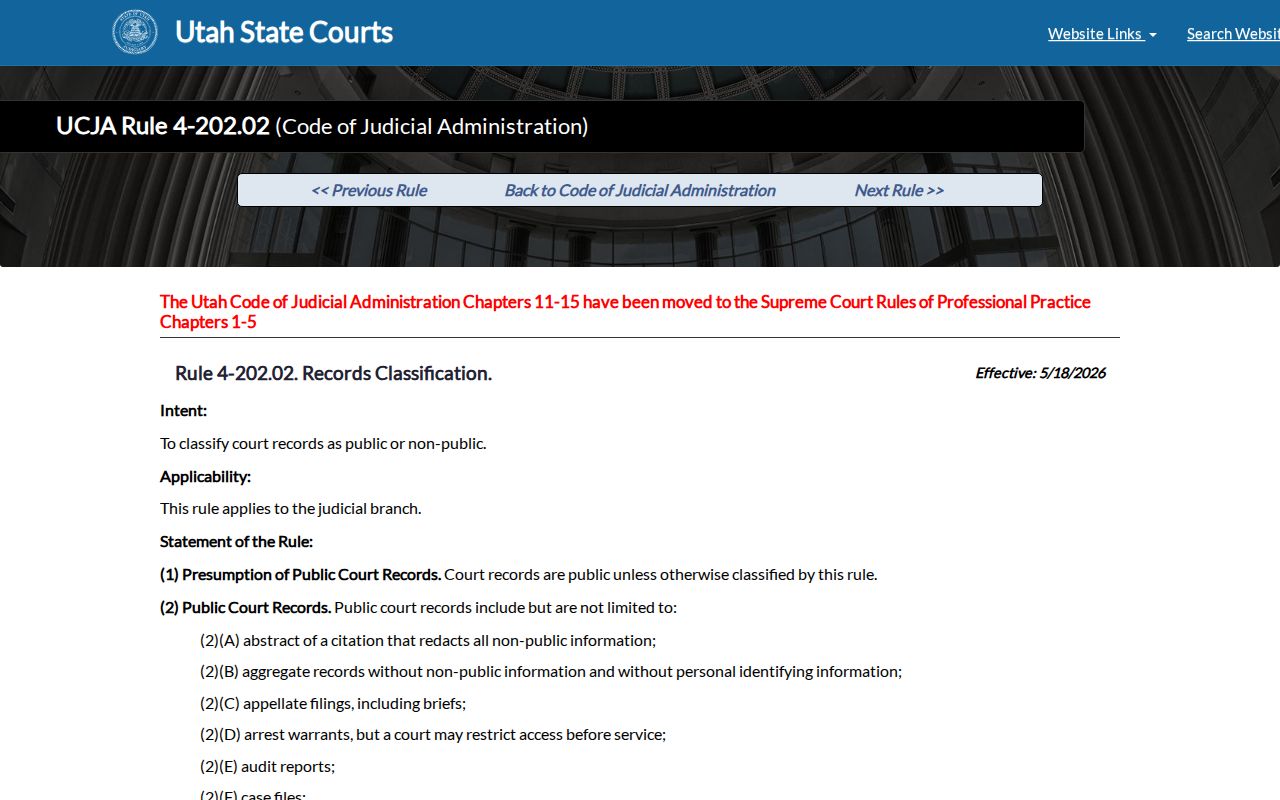
A public docket entry does not mean every attachment behind it is public. And a search that returns nothing does not prove the court never handled the matter.
Utah court-record rules:
Rule 4-202.03 allows anyone to inspect public records and requires entitlement or authority for nonpublic records.
Rule 4-202.04 provides a written access or classification request process.
Rule 4-202.08 supplies authority for court-record and Xchange fees.
Partial Emery File Releases
A clerk can release parts of an Emery County court record and redact the rest. Each item carries its own classification. There is no single public-or-secret stamp for the whole case. Nonpublic items may require proof of identity. They may also require an access entitlement, written authorization, or a court order. Use the Rule 4-202.03 and 4-202.04 process. State your legal basis for access. Attach the proof that supports it. The clerk may deny the request, release part of the file, or send the question to a judge. GRAMA governs many Utah government records, but judicial files usually follow the court's own Rule 4-202 system instead. Whatever the clerk releases, do not share it beyond the access authorization you were granted.