
Emery County Civil Docket Searches
The official route into a case is Utah Courts Xchange. Most Emery civil matters live in Castle Dale District Court. Small claims start in Emery County Justice Court. Bring an exact case number if you have one. Without it, search a party or company name. Pick the likely court, and narrow the location to Emery or Castle Dale. Filter by filing date or case type. For help with wildcards and what each result field means, the Xchange help page spells it out. Keep a complaint, notice, order, or small-claims paper at hand. It settles spelling, party roles, and court location before a broad name search buries you in lookalikes.
- Open Xchange and choose District Court or Justice Court.
- Enter the full case number, or search the party or company name with a wildcard.
- Narrow by Emery location, civil case type, and date range.
- Compare the caption and filing date before reading events.
- Request a certified copy from the clerk when formal proof is required.
Emery Civil Courts by Case
Utah District Court handles the general civil caseload. In Emery County the docket covers contracts, debt, torts, property rights, and domestic relations. It also reaches probate, civil stalking, and administrative matters. Justice Court takes small claims and a few limited civil items. A losing small-claims party may get a fresh start in District Court. The route is a trial de novo. That means a brand-new trial, not a review of the lower court's record.
| Matter | Likely court | Search route |
|---|---|---|
| General civil, probate, domestic | Castle Dale District Court | Xchange and district clerk |
| Small claims | Emery County Justice Court | Xchange and justice clerk |
| Small-claims trial de novo | District Court | District history plus lower case number |
For current clerk locations and contact details, the Utah Court Directory is the official listing. The county Clerk/Auditor does not keep these judicial dockets.
Civil Dockets: What They Show
Utah often labels the docket a case history or list of proceedings. The header shows the court and location. It also lists the case number, caption, filing date, case type, parties, attorneys, and judge. Below that, the events roll forward. You will see service, answers, motions, hearings, and mediation. Settlement, orders, judgment, and appeals follow. Treat a filed motion as nothing more than a request. It becomes a ruling only when the history or an order says so.
| Case Number | The full court-assigned identifier; it is not unique statewide, so confirm location. |
|---|---|
| Parties | Plaintiff and defendant, or petitioner and respondent, with role codes. |
| Filings | Dated entries for complaints, petitions, answers, and public documents. |
| Motions | Requests for judicial action and, separately, any ruling. |
| Judgment | The formal resolution, dismissal, or money award entered by the court. |
Emery Civil Case Codes
Utah's abbreviations come straight from the official Xchange case-type table. Handy civil codes include CN for contracts and DC for debt collection. EV covers eviction, SK civil stalking, and DA divorce. ST marks a small-claims trial de novo. Codes shift over time, so the live table wins. Party codes matter too: PLA is plaintiff, DEF defendant, PET petitioner, RES respondent. A name in the caption tells you nothing about who won. The role plus the later orders do that work.
What Cases Fill the Civil Docket
The FY2023 District Court report for Emery breaks its civil docket into general civil, domestic, probate, property-rights, tort, judgment, and civil-stalking categories. Those groups measure court workload. They say nothing about the merits of any claim.
- Contract, fraud, and debt-collection disputes
- Automobile and other tort claims
- Property rights, including eviction entries
- Divorce, custody, support, and protective matters
- Probate, estates, and Justice Court small claims
Emery Civil Caseload Snapshot
The FY2023 numbers show real volume. General-civil filings hit 118, with 113 dispositions. Debt collection drove 85 filings. Domestic came to 97, probate 35, and property rights 22, of which 18 were evictions. Remember these are totals, not party lists or outcomes.
A disposition can be a dismissal or another type of resolution. Never read that count as judgments won by plaintiffs.
Hearings on the Civil Docket
A setting is just a scheduled event, not a ruling. Check the Utah court calendar to confirm a date. You can search by case, party, judge, attorney, or location. Then match it against the Xchange case history. A scheduling order may set deadlines that never surface as public hearings, and a continuance can push a hearing back while the case lives on unchanged. Calendars shift, so recheck right before the event. Remote access shows up only if the court posts a link. The local Emery County court schedule keeps them apart. Castle Dale District settings sit separate from Emery Justice settings.
Emery Judgments Need Context
A judgment entry proves the court recorded a judgment. Nothing more. It does not prove the unpaid balance, enforceability, a current address, or lien status. Xchange can run judgment-specific searches. It may show accounting data too. But the underlying order and a current certified record carry more weight for legal or title work. Read the judgment disposition and every later event before you describe its status.
The FY2023 report lists 214 judgment entries across categories. That total includes 121 tax liens, 57 child-support liens, 26 abstracts, nine workforce-service liens, and one confession entry. Keep those categories separate. Xchange currently opens debt-collection documents when they are public, and other document types may follow. A public document link may carry the portal's stated per-document charge, while an authenticated clerk copy follows the court fee schedule instead.
Older Emery Civil Records
Xchange draws its data from Utah's CORIS system. Coverage started early in Emery County. Castle Dale linked up on January 13, 1997. Most district courts followed by the end of 1998. Age matters here. An old civil docket may show a thin history, few electronic filings, or nothing at all. Justice courts came online on their own schedules. So if you hold an old small-claims paper, read the court name on it with care before searching anywhere else.
Checked your spelling, dates, and both likely courts? Then call the clerk of the court that created the file. Records older than 50 years may sit at the Utah State Archives instead. Help the clerk help you. Offer a sensible date span and the likely caption. Add the case family, plus any order or judgment you know about. The official request form covers inspection as well as copies. So you can ask to view a public file first and pick pages afterward. One more caution. A blank result may point to a private, sealed, or restricted classification. That does not prove the case never existed, even in Xchange.
Coverage and paperwork are two different things. A docket entry can name a motion or an order yet give you no text. The flip side happens too: a newer debt-collection file may carry a link straight to a public document. You can see the event but not the paper. Ask the District Court clerk for that one filing. Name-based requests for everything at once just slow the line down.
The official Utah case-code reference lays out the civil categories used in public search today.
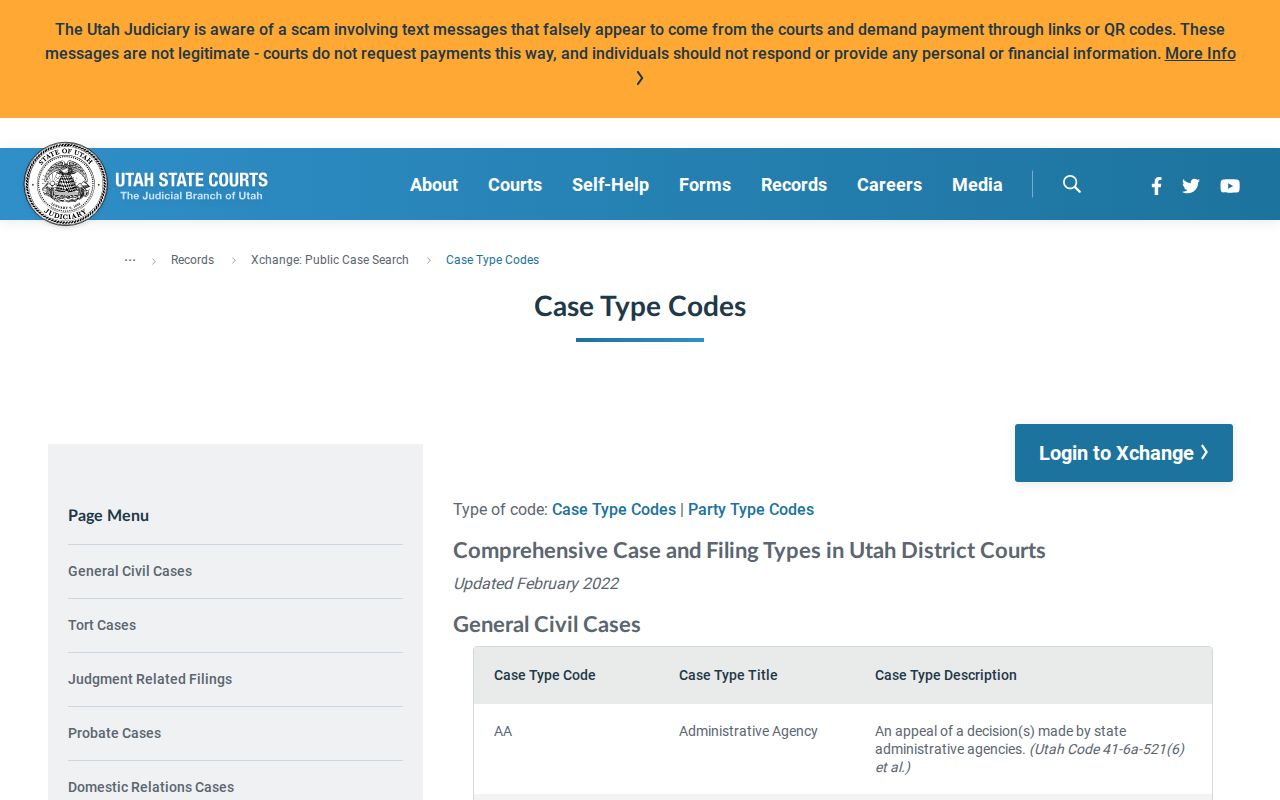
Search with the current labels, but expect odd coding or thin data in older Emery files.
Who Can See Civil Dockets
Utah presumes its court records open. A rule or law must say otherwise. A civil docket can be half public and half private. The case history, hearing minutes, judgments, orders, and decrees may stay visible. The pleadings and the papers behind them remain closed. Domestic relations, custody, guardianship, protective-order, stalking, and sex-designation cases often carry this mixed structure. So a caption in the docket never means the whole file is public.
Key Rules:
UCJA Rule 4-202.02 defines public, private, protected, and sealed court records.
UCJA Rule 4-202.03 allows public access while requiring authority for nonpublic records.
UCJA Rule 4-202.04 supplies a written access or classification request process.
Need a paper Xchange won't hand over? Use the court-record request process. List the court, the case number, the caption, the document, the date range, the format, and whether you want to inspect or copy. The clerk then decides access under the record's classification.