
Emery County Criminal Docket Searches
Utah Courts Xchange is the place the public actually searches. The District Court holds felonies and district-level criminal cases. The Justice Court handles most lower misdemeanors, infractions, and ordinance matters. Start with an exact case number. When you do not have one, narrow the search with the defendant name, court, Emery location, case type, filing date, citation number, violation date, and birth date. That separates people with similar names. The Xchange help page walks through wildcards and extended history. Keep your citation, charging paper, or hearing notice at hand. It settles spelling, charge level, and court location before a broad search buries you in lookalike names.
- Open Xchange and choose District Court or Justice Court.
- Enter the full case number, or search the party or company name with a wildcard.
- Narrow by Emery location, criminal case type, and date range.
- Compare the caption and filing date before reading events.
- Request a certified copy from the clerk when formal proof is required.
Emery County Criminal Docket Courts
Castle Dale District Court takes the state felonies and district-level criminal work. Emery County Justice Court covers most class B and C misdemeanors, infractions, traffic cases, and county ordinance charges. Juvenile Court handles youth delinquency, though public access is sharply limited there.
| Charge level | Likely court | Access route |
|---|---|---|
| State felony | Castle Dale District Court | Xchange, clerk, public terminal |
| Class B/C misdemeanor | Emery County Justice Court | Xchange, justice clerk, calendar |
| Youth delinquency | Emery County Juvenile Court | Clerk when access is authorized |
Current court locations come from the Utah Court Directory, and the county Clerk/Auditor does not keep these judicial dockets.
Criminal Dockets: What They Show
Utah often labels the docket a case history or list of proceedings. Identification fields cover the court, location, case number, filing date, defendant, attorney, and judge. They also cover charge, severity, citation number, violation date, and prosecuting agency. Events may include arraignment, motions, hearings, plea, trial, and disposition. Sentence, due dates, public documents, and accounting appear as well. Read it all with one caution. A filed charge stays an allegation. Only the disposition records a conviction.
| Case Number | The full court identifier; confirm court and location because it is not unique statewide. |
|---|---|
| Charge | The alleged offense, code, and felony, misdemeanor, or infraction severity. |
| Setting | A scheduled arraignment, pretrial hearing, trial, or sentencing event. |
| Plea | The defendant's recorded response, such as guilty, not guilty, or no contest. |
| Disposition | The court-entered outcome for each charge, including dismissal, acquittal, or conviction. |
Emery Criminal Codes and Outcomes
Case codes tell you what kind of matter you are reading. The Xchange case-type table defines FS as state felony and MD as misdemeanor DUI. It lists MO as other misdemeanor, and IF is infraction. Check the live table before trusting any code. A charge is still only an allegation, never a conviction. Follow each count to its plea and disposition. Describe a dismissal, acquittal, conviction, or plea in abeyance using the exact status the court entered.
Criminal Case Stages on the Docket
A case can run from a filed charge through arraignment, pretrial settings, motion practice, plea or trial, disposition, and sentencing. Not every case touches every stage. A setting is just a scheduled event, and a reset never dismisses the charge.
- Charge filed and case number assigned
- Initial appearance or arraignment
- Pretrial settings and motions
- Plea or trial
- Disposition and sentencing
Emery Criminal Caseload Snapshot
FY2023 statistics report 161 District Court criminal filings and 177 dispositions. The filings break down into 83 state-felony, 46 other-misdemeanor, 14 misdemeanor-DUI, and 18 with no applicable severity. These are aggregate counts, not names and not conviction totals.
The disposition-to-filing ratio that period was 110 percent. Courts also resolved matters filed earlier. State-felony dispositions totaled 114, other-misdemeanor dispositions totaled 44, and misdemeanor-DUI dispositions totaled five. No-applicable-severity dispositions totaled fourteen. That timing effect matters. A disposition total will never match the same year's new cases one for one.
Justice numbers are reported separately and carry heavy traffic volume. Castle Dale Justice reported 2,117 total filings and 1,995 dispositions. The historical Green River row showed 177 filings and 170 dispositions for FY2023. Both reports include categories beyond the core District Court criminal docket. Use neither to infer one person's outcome.
Emery Criminal Calendar Settings
A setting is a scheduled event, not a decision. Confirm any date through the Utah court calendar by case, party, judge, attorney, or location. Then compare it with Xchange's case history. A scheduling order may set deadlines that never surface as public hearings. A continuance can move a hearing without ending the case.
Check again close to the event. Calendars change. Remote access shows up only when the court supplies a link. The local Emery County court schedule separates them. Castle Dale District settings and Emery Justice settings stay apart there.
Emery Rights and Waiver Form
The Emery County Justice Court page links local rights material on counsel, self-representation, jury, confrontation, witnesses, silence, plea options, bail, appeals, and penalties. The form lists several authorized plea choices. It lets a defendant represent oneself, retain counsel, or seek appointed counsel through the stated screening process. It covers the timing of a written jury demand plus a local notice-of-appeal instruction. The form helps explain procedural entries. It cannot predict a sentence or result.
A filed waiver may show up as one event among many. Look for later entries. They may show counsel, an arraignment, a plea, a trial setting, or another order. Read printed penalty ranges alongside the current charge, statute, and Utah Uniform Fine Schedule. Rights paperwork is not a plea or disposition unless the court history records that event.
Older Emery Criminal Record Gaps
Older Emery County criminal dockets can look thin, and the reason is technical. Xchange pulls its data from Utah's CORIS system. Castle Dale came online there on January 13, 1997. The justice courts converted later, each on its own schedule. A case from before those dates may show only a few events. It might hold a handful of documents. Or it may show nothing at all in the system.
Before assuming a file is gone, check a few things yourself. Try alternate spellings and different dates. Confirm whether the matter belonged to District or Justice court. Then contact the clerk that created the record, or the Utah State Archives. A blank result can also mean the case is juvenile, sealed, expunged, or private. For a paper-era matter, give the clerk the closest filing period you know. Add the charge type, caption, and court location. A narrow request like that saves staff time. It also helps them tell an archived file from one the law restricts.
Modern filing tools add their own confusion. Utah eFile delivers papers to the court, but it is not a public docket viewer. MyCourtCase serves an eligible participant who needs that person's own linked case. Xchange is the tool for general public case-history search. The calendar plays a third part; it confirms a setting. Open the wrong system and a case that exists can look missing. The official district filing instructions lay out separate criminal and citation filing routes in detail.
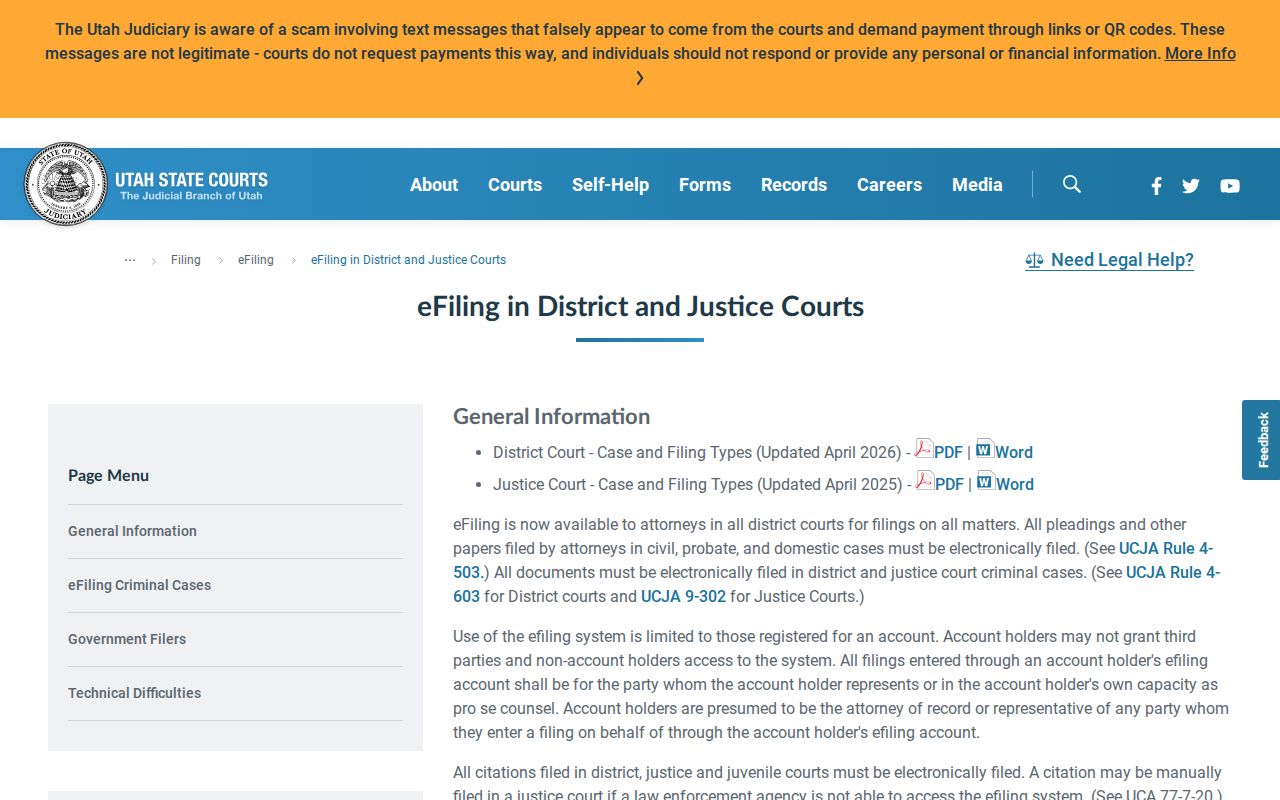
The image illustrates current filing channels, not the completeness of an older public docket.
Access Rules for Criminal Dockets
Utah court records start out public. A rule or law can move a file into another classification. That is all it does. When an Emery County criminal docket is public, the case history can show the charged violation. It can also show current case status, attorney, proceedings, orders, and material from open hearings. Some records sit outside ordinary Xchange access no matter what. Juvenile delinquency, child welfare, adoption, commitment, expunged, and sealed files are all excluded. One caution: a public caption does not make every document inside the file public.
Key Rules:
UCJA Rule 4-202.02 defines public, private, protected, and sealed court records.
UCJA Rule 4-202.03 allows public access while requiring authority for nonpublic records.
UCJA Rule 4-202.04 supplies a written access or classification request process.
When Xchange lacks a document you need, the court-record request process is the next step. Spell out the court, case number, caption, the document, the date range, your format, and whether you want inspection or a copy. The clerk then applies the record's classification and decides what access to grant.